

This article is the third part of a new series, Yesteryear at Gallaudet, featuring the historical records of Gallaudet University.
Note: This article was originally published on Medium on June 15, 2025, and has been republished here in its entirety.
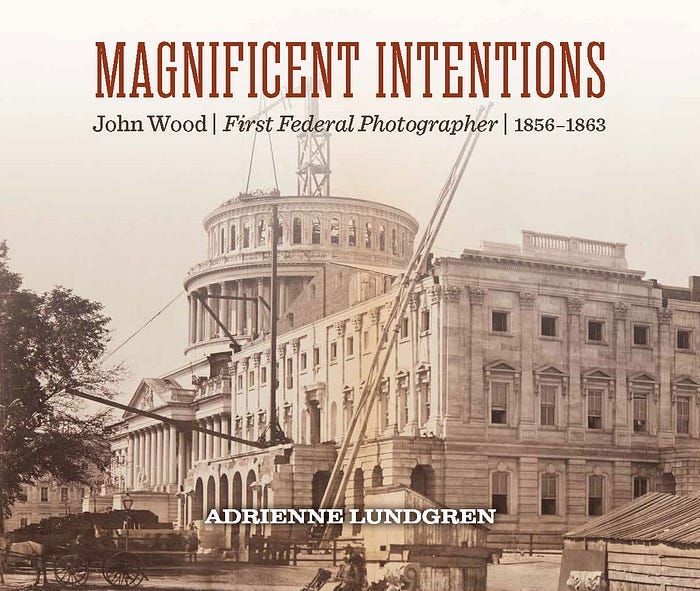
A book was recently published, Magnificent Intentions: John Wood, First Federal Photographer (1856–1863), by Adrienne Lundgren, a senior photograph conservator in the Library of Congress Conservation Division.
Magnificent Intentions sheds light on the little-known photographer in the history of photography, John Wood (1838–1901), who was the first federal photographer. He took the photographs of President James Buchanan’s inauguration on March 4, 1857, which is believed to be the first known photograph of a Presidential inauguration, and President Abraham Lincoln’s first inauguration on March 4, 1861.
Drawing upon historical information and known records, Harris & Ewing, Inc., Mathew Brady, and Alexander Gardner were widely recognized in the photography industry in Washington, DC, but John Wood, despite his significant contributions as the first federal photographer, was largely overlooked.
John Wood was hired in May 1856 by Montgomery C. Meigs, the Architect of the Capitol, to document building projects in the DC area. He served as a “photographic draftsman” for the US Capitol expansion project from 1856 to 1861, primarily photographing architectural drawings.
Among the key contributions made by John Wood were:
Documentation of major public building constructions in DC, including the US Capitol and the Washington Aqueduct
Pioneering innovations in using photography to duplicate maps and plans during the Civil War
Creation of some of the first panoramic photos of Washington, DC
Despite his pioneering career, John Wood’s work was largely forgotten for many years. Magnificent Intentions has brought renewed attention to his significant role in the history of photography and the documentation of a transformative period in the nation’s capital. The book contains essays about John Wood and his works, including his photographs, mostly from the Library of Congress and various museums, as well as the methods of developing photographs using both wet and dry collodion processes.
A view of Kendall Green in 1861
Michael J. Olson, a retired archivist after 38 years at the Gallaudet University Archives and a walking encyclopedia of Deaf History, has extensive experience processing historical photographs in the Gallaudet University Archives. He was the photography consultant for the book, The History of Gallaudet University: 150 Years of a Deaf American Institution (2014).
Samuel M Sonnenstrahl, Director of Alumni Relations from 2002 to 2022, gave a testimony at the retirement reception for Mike Olson on February 12, 2020, “I appreciate having Mike here. For information on alumni and the history of Gallaudet University, the best person to ask is him. Sometimes, I unpack the boxes of photographs from class reunions, many of which were taken a long time ago, such as the 1900s, and before that. I would need to identify who was in these photographs. I would ask him and he would recognize some people. I would learn, ‘Oh, I know these names, but I didn’t know their faces.’ I feel like he was there from the founding of Gallaudet University to the present time. He was there! I honestly feel like he was there from the beginning to now.”
Mike Olson’s knowledge offers an invaluable perspective, like he has a time machine, back to the early days of Gallaudet University.
Olson now enjoys every day as if it were Saturday, and found out about the new book, Magnificent Intentions, by reading the book section in the Washington Post Sunday Edition. He knew it was worth purchasing to have the book because he has a long-standing interest in the history of DC, which we share. He ordered the copy through Amazon and received it quickly on the evening of Thursday, May 16, 2024.
Looking through the pages, he saw a photograph on page 177, and he knew that the campus of Kendall Green, then known as the Columbia Institution for the Instruction of the Deaf and Dumb and the Blind (C.I.D.D.B.), must be in that photograph. That photograph is a view of Washington, DC, looking northeast from the US Capitol with the Senate skylight in the foreground, taken on June 27, 1861.
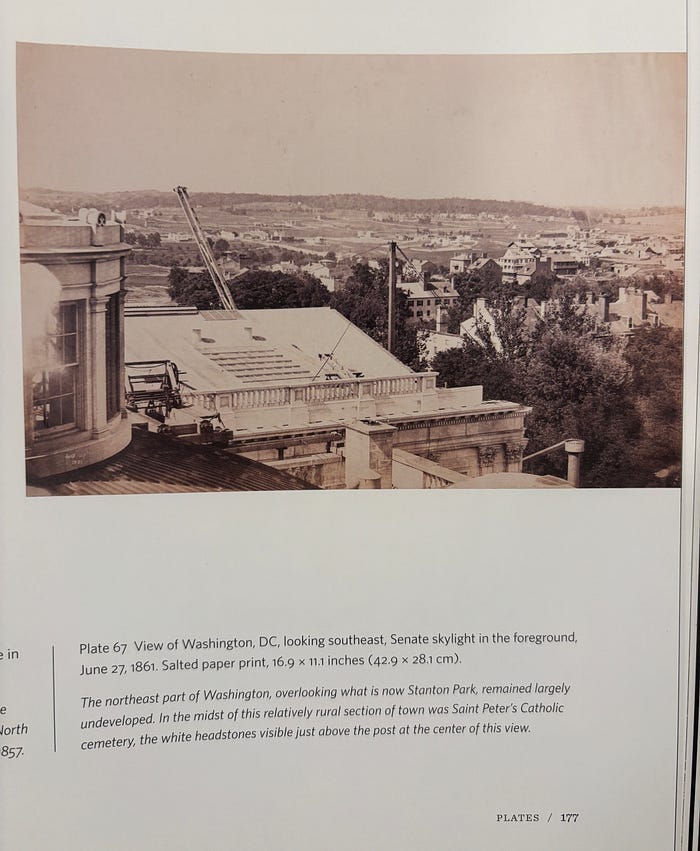
The next day, on Friday morning, he zoomed to the Library of Congress Prints and Photographs Division. He requested to look at that specific photograph. The division said that it was already digitized, but it wasn’t uploaded to the online catalog yet. So, they pulled the original photograph and provided the magnificent glass for Olson to look at it. Then, he peered and peered at the photograph for several minutes, and he finally found the campus of Kendall Green!
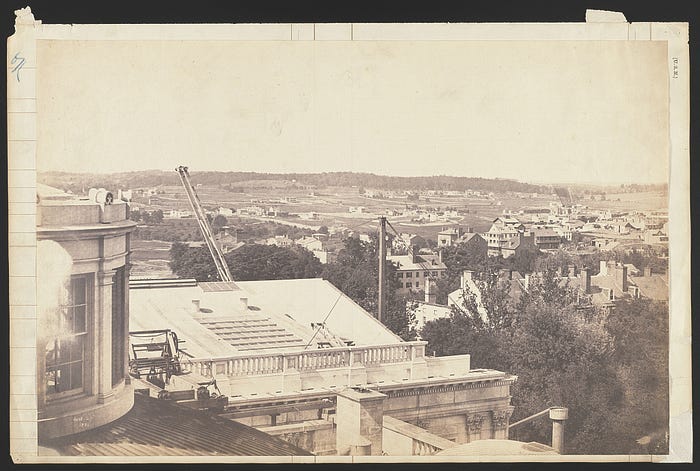
This original photograph is a salted paper print, sized in 16.9 x 11.1 inches (42.9 x 28.1 cm).
Let’s zoom this photograph to find the campus of Kendall Green…
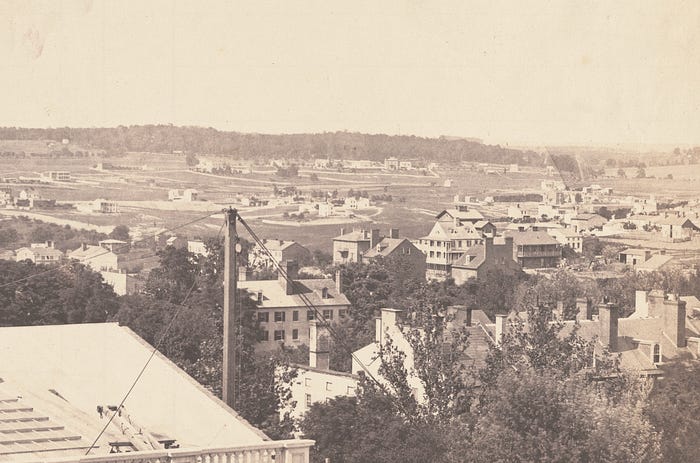
Close…
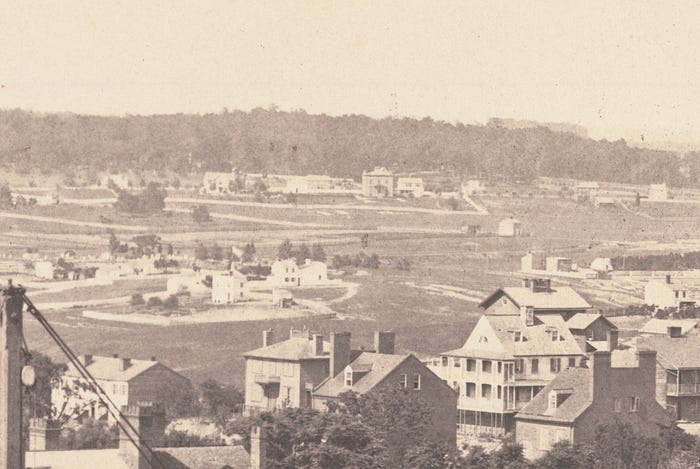
Closer…
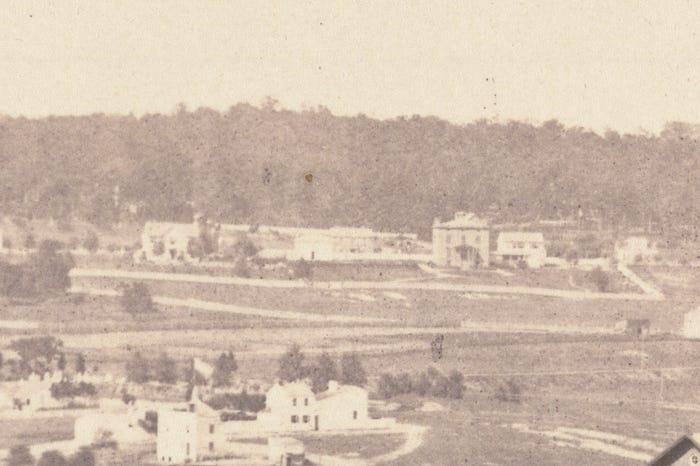
Closest!!!
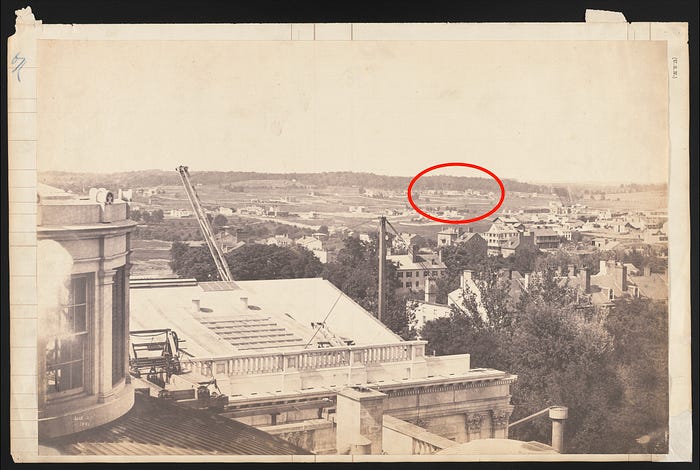
Zoom out… The red circle is the campus of Kendall Green.
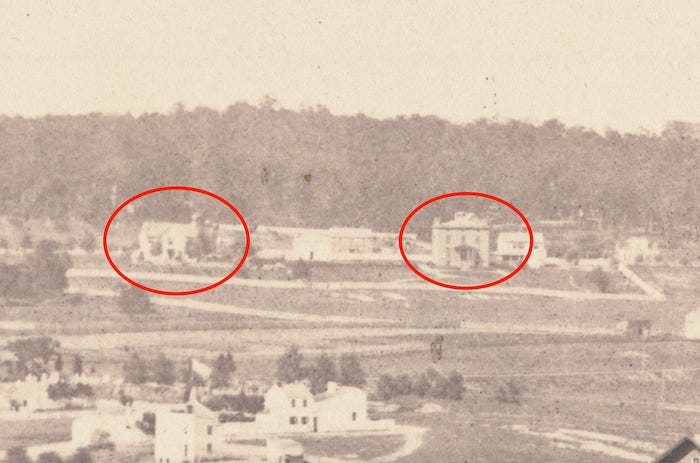
Zoom in again… The red circle on the left is the Rose Cottage, and the red circle on the right is the Primary Department Building.
Rose Cottage
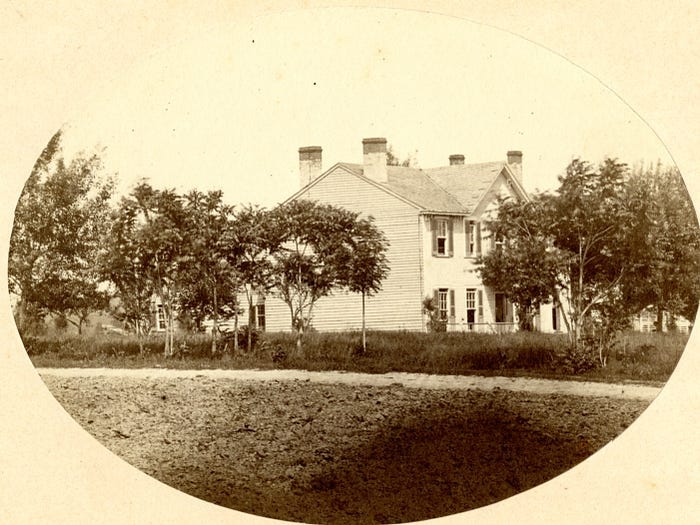
This photograph is the Rose Cottage, known as “The Cradle of Gallaudet,” taken in 1866. Built in 1854, the Rose Cottage was originally the home of William Stickney, a son-in-law of Amos Kendall, who was the founder of C.I.D.D.B. and owned the land named after Kendall Green. There was a large rose garden between the two houses of Stickney and Kendall. The Stickney House, with 2 floors and 10 rooms, became known as Rose Cottage. From 1864 to 1866, it was the first building used for Gallaudet University. It was razed between 1866 and 1871 to make space for the construction of the Main Central Building, now known as Chapel Hall.
Primary Department Building
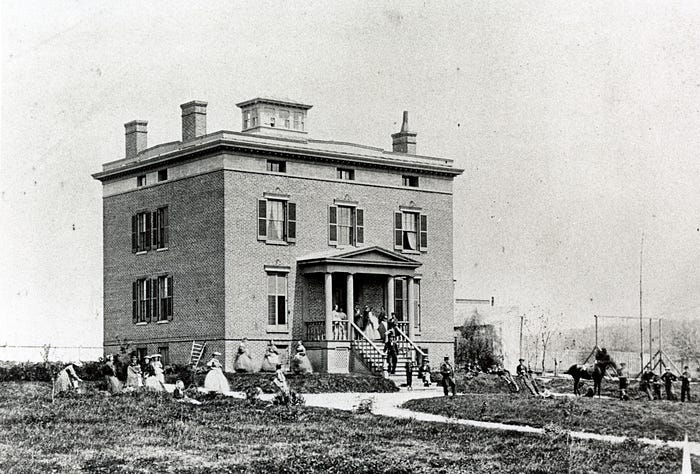
The Primary Department Building was designed by the architect Emil L. Friedrich. It was built in 1859 by the contractor James G. Naylor. The building was constructed with bricks, parapets with pediments, belvederes, and four rectangular chimneys. The building was altered with the addition of a larger building in front of it in 1862.
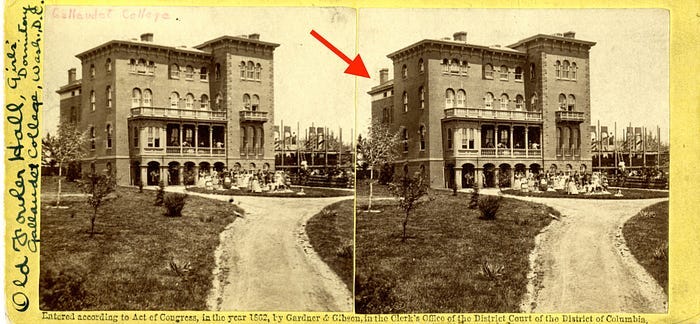
A larger building with four floors, it housed the Columbia Institution's primary department pupils. The western section had 12 rooms, hospital rooms, a chapel, a dining room, and a library. The eastern section had a large sitting room for the boys, a bathroom, classrooms, and dorm rooms. The President’s residence was in that building for a while before the Edward Miner Gallaudet Residence (House One) was built in 1867–1868.
The Primary Department Building was demolished in 1916 due to fire hazards. A current building, Fowler Hall, was constructed in its place in 1918 and named after Sophia Fowler Gallaudet, wife of Thomas Hopkins Gallaudet and the first matron of the Columbia Institution.
From the view of Kendall Green in 1861, that was before the Chapel Hall and its iconic Tower Clock were built in 1871!
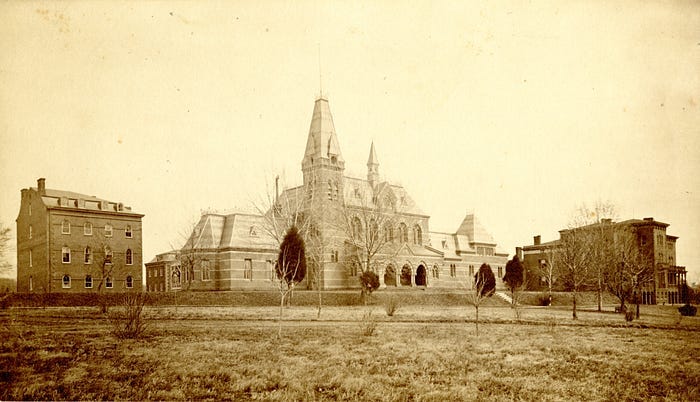
14 years later, this photograph was taken in 1875, the buildings from left to right were the East Wing building, built in 1866, which had an addition in 1877, and is now College Hall. In the middle, Chapel Hall and its Tower Clock, and the Primary Department Building on the right.
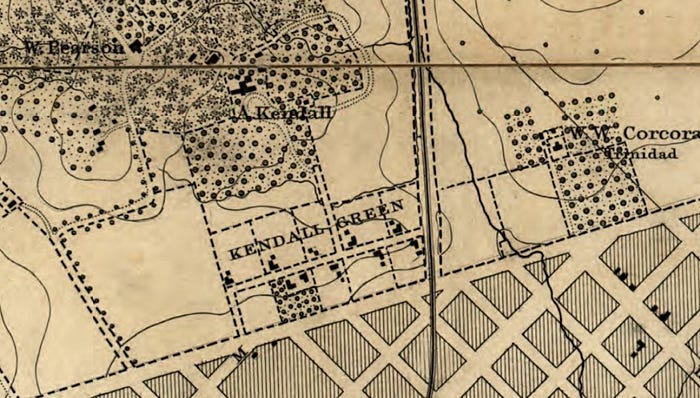
An illustrated map by D. McClelland, Blanchard & Mohun in 1861 depicts the property of Kendall Green, which ambiguously shows that the lots and buildings resemble those seen in John Wood’s photograph from the same year.
What a cool find of a photograph by Mike Olson!
Now, you can visualize the evolution of the campus on Kendall Green in the early days.
A note on the evolution of names for Gallaudet University
Established in 1857 as the Columbia Institution for the Instruction of the Deaf and Dumb and the Blind (C.I.D.D.B.), the institution saw significant transformations over the years. In 1864, President Abraham Lincoln signed an act to authorize the college, becoming the National College for the Deaf and Dumb. The following year, 1865, the blind students were transferred out, and the institution’s name evolved to the Columbia Institution for the Deaf and Dumb (C.I.D.D.), with the renaming of the college, National Deaf-Mute College. The Primary Department, which was part of the institution, was renamed the Kendall School in 1885 to honor Amos Kendall.
In 1894, the college was renamed as Gallaudet College in tribute to the Rev. Thomas Hopkins Gallaudet. Subsequent corporate name changes included Columbia Institution for the Deaf in 1911 and then to Gallaudet College as a corporate name in 1954. The Model Secondary School for the Deaf opened on campus in 1969, followed by the Kendall Demonstration Elementary School in 1970. Finally, in 1986, Gallaudet College achieved university status, becoming Gallaudet University with the signing of the Education of the Deaf Act by President Ronald Reagan.
Collections of photographs by John Wood at the Library of Congress (LOC)
John Wood Photographs — LOC Catalog
John Wood Photographs — LOC Prints & Photographs Online Catalog
“Photographs of Washington, D.C.” — LOC Prints & Photographs Online Catalog
Videos on John Wood: U.S. Capitol Photographer (1856–1864)
John Wood: U.S. Capitol Photographer (1856-1864) — LOC Catalog

Magnificent Intentions: John Wood, First Federal Photographer — YouTube
Sources:
Armstrong, David F. The History of Gallaudet University: 150 Years of a Deaf American Institution. Washington, DC: Gallaudet University Press, 2014.
Gallaudet University. “The History of Names for Gallaudet University.” Accessed June 15, 2025. https://gallaudet.edu/museum/history/the-history-of-names-for-gallaudet-university/.
Gilmore, Matthew B. “Adrienne Lundgren — Interview with a Washington DC History Author — ‘Magnificent Intentions: John Wood, First Federal Photographer (1856–1863).’” Washington DC History Resources (blog), July 14, 2024. https://matthewbgilmore.wordpress.com/2024/07/14/adrienne-lundgren-interview-with-a-washington-dc-history-author-magnificent-intentions-john-wood-first-federal-photographer-1856-1863/.
Library of Congress Newsroom. “New Book ‘Magnificent Intentions: John Wood, First Federal Photographer’ Documents Building of Nation’s Capital in Pictures,” April 30, 2024. https://newsroom.loc.gov/news/new-book--magnificent-intentions--john-wood--first-federal-photographer--documents-building-of-natio/s/9804ae0d-ad7a-4b87-8cd7-3835b13edf54.
Lundgren, Adrienne. Magnificent Intentions: John Wood, First Federal Photographer (1856–1863). Washington, DC: Smithsonian Books, 2024.
The Gallaudet Almanac 1864–2014. Washington, DC: Gallaudet University Alumni Association, 2020.